
Breaking Down Design System Effort by Week

A big thank you to our sponsor who keeps this newsletter free to the reader:
Get a design system for your enterprise up and running by the end of the year with Design System in 90 Days, the newest program at Design System University. Meet weekly with a cohort of your peers as founder Dan Mall—that’s me!—takes you through the 133-page workbook in a way that”s actionable and fun. Registration opens on Monday August 21.
Reading time: around 2 minutes
Imagine that you have 12 weeks (roughly 90 days or 3 months) from the start of next month to create a design system from scratch. You’re given a team of a designer, a lead engineer, a writer, and a DesignOps person (all senior level individual contributors), and you’re forecasting what each of their involvements might look throughout.
How would you do it?
(For some of you that I’ve even heard from directly, this isn’t a hypothetical; it’s the exact situation you’re in.)
I’ve worked with teams in this situation many times before, and here’s the average of where we landed. This isn’t broken down by time. It’s more about relative effort week to week. Here are some questions these kinds of views can answer:
How does group effort change week to week?
How does individual effort change week to week?
How does each person’s effort compare to everyone else’s each week?
Who drives the team each week?
Here’s a look at how the overall team effort waxes and wanes over a 12-week period, using an oversimplified unit of “quantity of tasks” as a reference point.
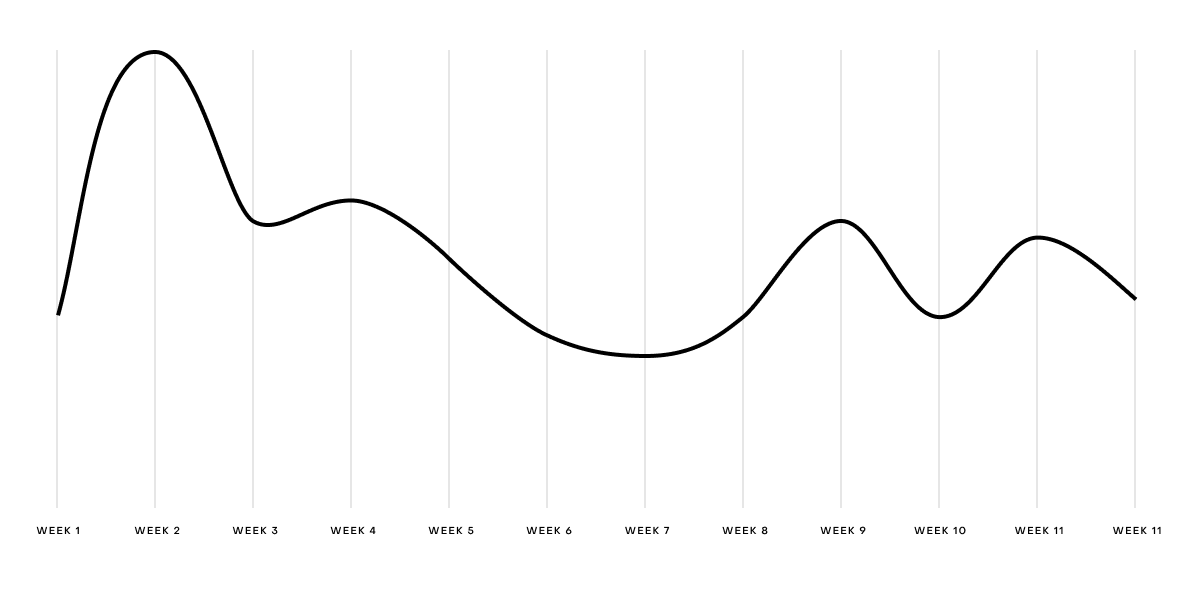
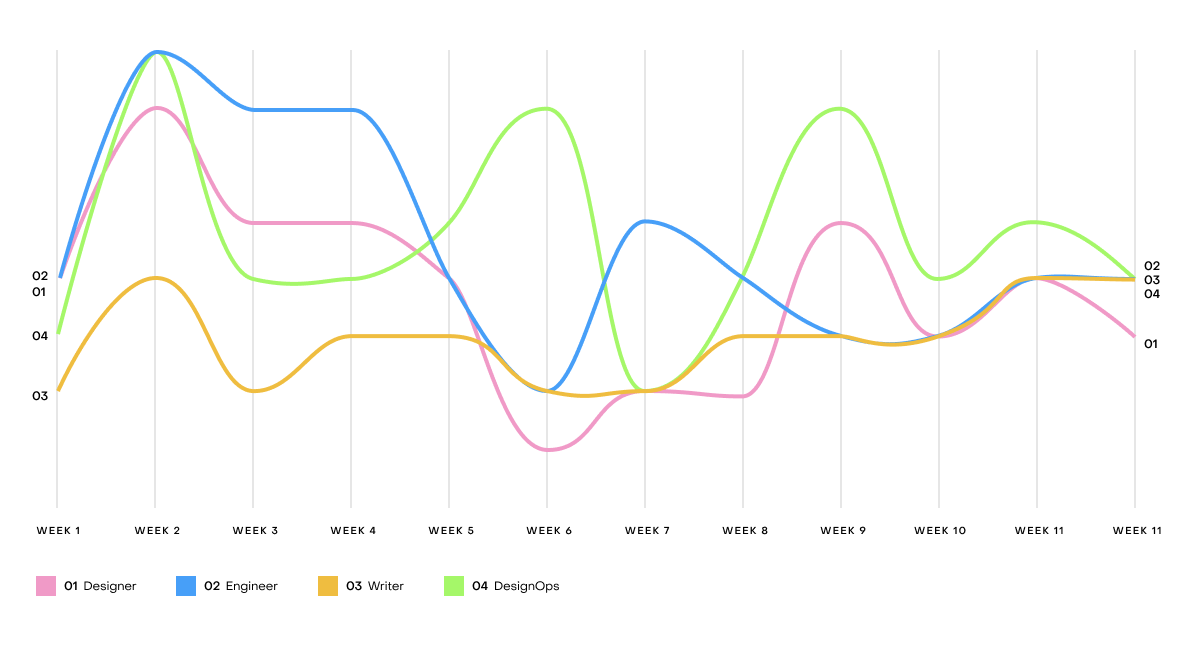
Here’s how that would break down across the 4 separate roles.
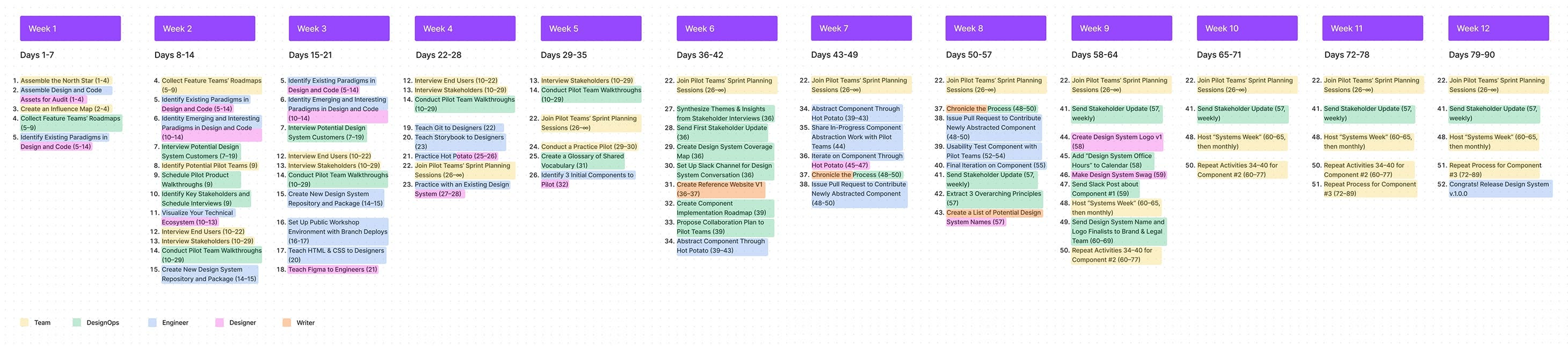
Here’s a breakdown of work to be done each week.
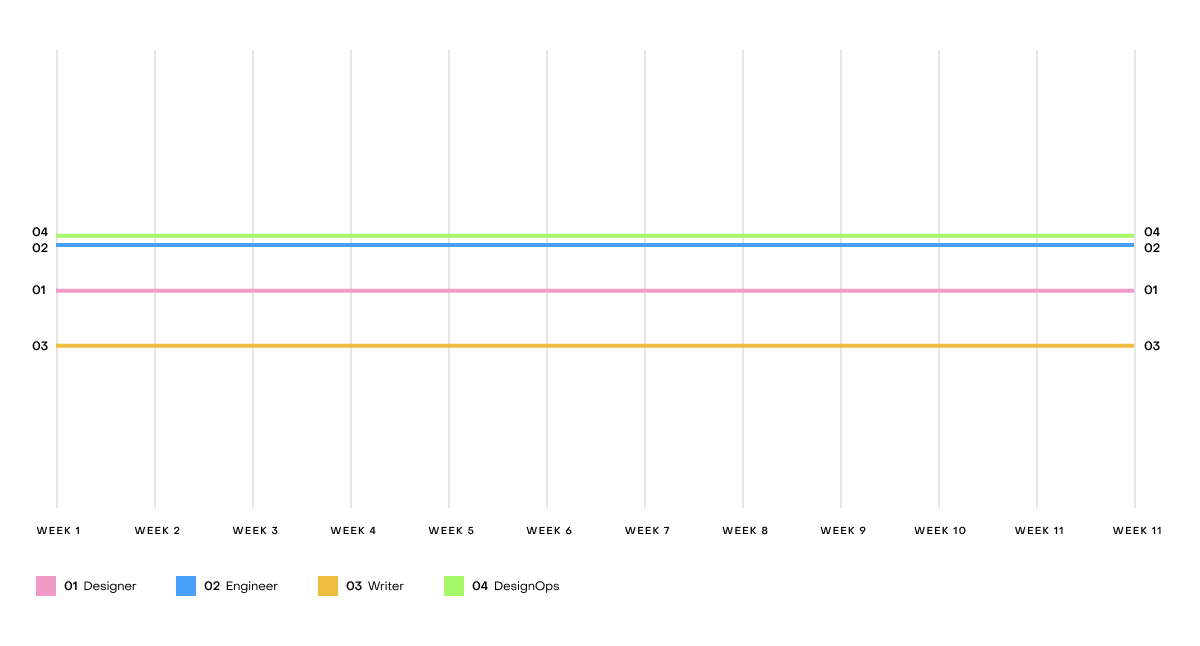
If we average the amount of work each role would have to do across an entire 3-month window, here’s how it would break down.
A few interesting observations that might be a bit askew from typical expectations:
The more natural pairing for design system product work is Engineer + DesignOps, surprisingly not Engineer + Designer or Designer + DesignOps.
Even though Engineer + DesignOps is the most natural pair, each role’s work acts as a counterpoint to the other. For most weeks, when the Engineer’s work is highest, the DesignOps person’s work is lowest, and vice versa. That makes a lot of sense when you think about the fact that design system work is equal parts tactical and operational but not always at the same time.
Despite being called a design system, the Designer’s work is typically to support the Engineer and drive marketing/branding efforts when it’s time to socialize and/or broaden the design system reach.
This is the kind of deep work and analysis we’ll be exploring more of in my newest program at Design System University called Design System in 90 Days. It’s a live cohort where I’ll teach you and your team every week for 12-weeks how to get a design system up and running—and adopted!—by the end of the year. Registration opens Monday, August 21 at 10am Eastern. I’ll share a discount code exclusively for readers of this newsletter in next week’s issue.
Were you surprised by any of the observations here? How closely does this match—or not—your design system experience? Reply and let me know.
—Dan
📰 Latest News
✊ Twitter drama rears its head again! I posted some (more) thoughts about racism in the design industry.
👷♀️ I love this advice from President Obama about learning to get stuff done so much. I can’t stop thinking about it this week.
🐦 I’ve really been enjoying Riley Jones’s Twitter account recently. He posts fun prompts that I can’t help but reply to like “Let’s play a pricing game. What would you charge for…?”, “Designers that remember starting a new role: How do you best take advantage of your first 30 days?”, and more.
💬 Feedback
How’d you like today’s email?
👍 Loved it / 👎 Hated it